EcoFlow Delta Pro & Jackery HomePower 3000 share many similarities, but there are also important differences, such as quality, performance, features, design, and connectivity. If you want the best one between them, I Would recommend the EcoFlow Delta Pro rather than the Jackery HomePower 3000.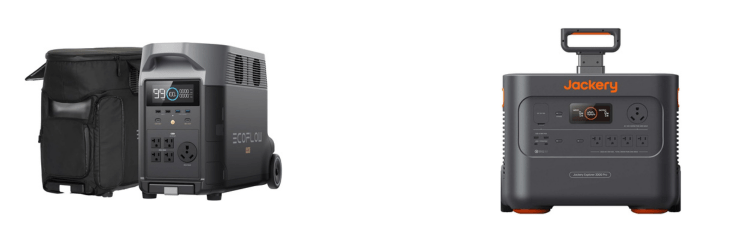
Why Do I Recommend The EcoFlow Delta Pro?
- The EcoFlow Delta Pro features a 3600W pure sine wave inverter for powering larger home appliances like air conditioners and dryers simultaneously, while the Jackery HomePower 3000 uses a 3000W inverter.
- EcoFlow Delta Pro includes a 3600Wh LiFePO₄ battery for extended runtime and deeper discharge capability during long outages, whereas the Jackery HomePower 3000 has a smaller 3024Wh LiFePO₄ battery.
- It supports up to 25kWh of expandable capacity to sustain multi-day home backup systems, while the Jackery HomePower 3000 expands only up to around 18kWh.
- The EcoFlow Delta Pro supports 120/240V split-phase operation for running 240V appliances such as dryers or well pumps, while the Jackery HomePower 3000 is limited to 120V single-phase output.
- EcoFlow Delta Pro comes with a faster AC charging rate of approximately 1.8 hours to reach full capacity for quicker turnaround between uses, whereas the Jackery HomePower 3000 takes about 2.0 hours for a full charge.
- It supports EV-station Level 2 charging to enable high-speed recharging from electric vehicle infrastructure, while the Jackery HomePower 3000 does not include EV charging capability.
- The EcoFlow Delta Pro integrates with the Smart Home Panel for seamless whole-home circuit connection and automated power management, whereas the Jackery HomePower 3000 supports only basic manual transfer switch connections.
- EcoFlow Delta Pro includes an integrated wheel and telescopic handle design for easier transportation across surfaces, while the Jackery HomePower 3000 lacks built-in wheels.
Maybe the Jackery HomePower 3000 can make you comfortable because it’s a little bit cheaper than the EcoFlow Delta Pro. But you have to compromise all the above-mentioned features. Now the Decision is Yours. I hope it was helpful to choose the right one.
Side-by-Side Comparison
| Feature | EcoFlow Delta Pro | Jackery HomePower 3000 |
| Battery capacity (base) | 3600Wh | 3024Wh |
| Max expandable capacity | Up to ~25kWh | Up to ~18kWh |
| Inverter (continuous) | 3600W | 3000W |
| Inverter (surge) | ~7200W | ~6000W |
| 120/240V split-phase | Yes | No native 240V |
| RV 30A (TT-30) | Yes | No |
| AC outlets (US) | 5 × 120V | 3 × 120V |
| Solar input (max) | ~1600W | ~1400W |
| Solar voltage range | ~11–150V | ~11–60V |
| AC recharge 0–100% | ~1.8 hours | ~2.0 hours |
| EV-station charging | Level 2 via adapter | Not supported |
| Parallel operation | Yes | No official |
| Home integration | Smart Home Panel | Basic transfer switch |
| Smart generator link | Yes | No direct equivalent |
| Battery cycle life (to 80%) | ~3500 cycles | ~1000–2000 cycles |
| Operating temp (charge) | Wider low-temp support | Standard low-temp support |
| Wheels/handle | Integrated trolley | Compact, no trolley |
| Weight | ~45 kg | ~29–33 kg |
| Dimensions | Larger footprint | Smaller footprint |
| DC outputs | Car socket + DC5521 | Car socket only |
| USB-C PD | Dual 100W | Single/Dual up to 100W |
| Car input charging | 12V/24V higher wattage | 12V/24V lower wattage |
| Ecosystem accessories | Broad | Narrower ecosystem |
| Price | Check EcoFlow Pro Price | Check Jackery 3000 Price |
What Common Both Can Do?
- Battery Type: Both power stations use LiFePO₄ battery chemistry, which provides higher cycle life, improved safety, and stable voltage output compared to standard lithium-ion cells. This makes them reliable for long-term home and outdoor energy use.
- Pure Sine Wave Inverter: Each model outputs clean AC power using a pure sine wave inverter, ensuring compatibility with sensitive electronics like computers, medical devices, and appliances.
- Portable Power Station: Both units are designed as portable all-in-one energy systems that can be moved and deployed for home backup, camping, or mobile power applications.
- AC Charging Supported: Each system supports direct AC wall charging, allowing users to quickly recharge from standard household outlets for convenience during grid access.
- Solar Charging Supported: Both models can connect to solar panels for renewable, off-grid power generation, enabling sustainable energy replenishment in remote or emergency conditions.
- Car Charging Supported: Each supports charging through a car’s 12V or 24V outlet, providing a mobile recharge option while traveling or during extended outdoor trips.
- App Control via Wi-Fi/Bluetooth: Both units feature smartphone connectivity for remote monitoring, control, and firmware updates through their respective apps.
- LCD Display: Each has a built-in digital display that provides real-time information such as remaining battery capacity, input/output power, and charging status.
- Multiple AC Outlets: Both power stations include several AC outlets to run or charge multiple devices simultaneously, suitable for home or field use.
- USB-A Ports: Each provides standard USB-A outputs for charging small electronics like phones, tablets, and accessories.
- USB-C PD Ports: Both include high-power USB-C PD ports to support fast charging for modern devices such as laptops, drones, and cameras.
- Car Power Output: Each unit includes a regulated 12V car socket output for running automotive or DC-powered devices safely.
- BMS Protection System: Both integrate an advanced Battery Management System that regulates voltage, temperature, and current to prevent overcharging or short circuits.
- Overload / Short-Circuit Protection: Each power station includes multiple hardware and software safeguards against overload, overcurrent, and short-circuit conditions.
- Smart Battery Management: Both manage charging and discharging efficiently to extend battery life and optimize performance under various load conditions.
- Parallel Expansion Capability: Each can be expanded with additional batteries or units to increase total storage capacity and power output for larger needs.
- Expandable Battery Option: Both systems support external battery modules, allowing users to extend runtime during prolonged outages or off-grid living.
- Home Backup Ready: Each power station can function as a backup source for essential home circuits, ensuring power continuity during blackouts.
- UPS/EPS Function: Both provide automatic power transfer (uninterruptible power supply) to prevent interruptions to sensitive electronics during power loss.
- Compatible with Solar Panels: Each unit is engineered for compatibility with third-party or branded solar panels, supporting off-grid and renewable operation for energy independence.
Common Features
| Feature | EcoFlow Delta Pro | Jackery HomePower 3000 |
| Battery Type | LiFePO₄ | LiFePO₄ |
| Pure Sine Wave Inverter | Yes | Yes |
| Portable Power Station | Yes | Yes |
| AC Charging Supported | Yes | Yes |
| Solar Charging Supported | Yes | Yes |
| Car Charging Supported | Yes | Yes |
| App Control via Wi-Fi/Bluetooth | Yes | Yes |
| LCD Display | Yes | Yes |
| Multiple AC Outlets | Yes | Yes |
| USB-A Ports | Yes | Yes |
| USB-C PD Ports | Yes | Yes |
| Car Power Output | Yes | Yes |
| BMS Protection System | Yes | Yes |
| Overload / Short-Circuit Protection | Yes | Yes |
| Smart Battery Management | Yes | Yes |
| Parallel Expansion Capability | Yes | Yes |
| Expandable Battery Option | Yes | Yes |
| Home Backup Ready | Yes | Yes |
| UPS/EPS Function | Yes | Yes |
| Compatible with Solar Panels | Yes | Yes |
| Price | Check EcoFlow Pro Price | Check Jackery 3000 Price |
FAQ
What type of battery do the EcoFlow Delta Pro and Jackery HomePower 3000 use? How long can each power station last on a full charge? Can both units be expanded with extra batteries? Do both models support solar charging? Can they power high-wattage appliances like air conditioners or refrigerators? Are both compatible with home backup systems? Can I charge these power stations using my car? Do they have mobile apps for monitoring and control? Do both have UPS (Uninterruptible Power Supply) capability? Are both units portable? What kind of inverter do they use? How long do their batteries last before degrading? Can both be charged through multiple methods? Do both have built-in safety systems? Which model is better for large-scale power needs? |