Cricut Maker 4 & Cricut Maker 3 share many similarities, but there are also important differences, such as quality, performance, features, design, and connectivity. If you want the best one between them, I Would recommend the Cricut Maker 4 rather than the Cricut Maker 3. 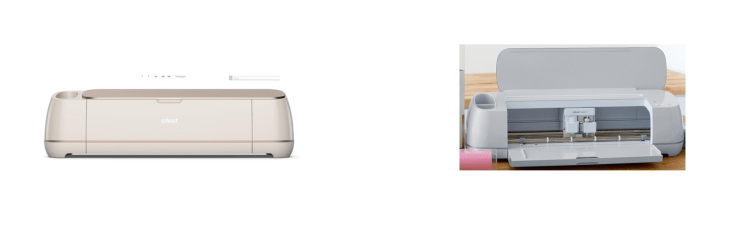
Why Do I Recommend The Cricut Maker 4?
- The Cricut Maker 4 features a next-generation cutting motor for significantly faster operation and reduced project completion time, whereas the Cricut Maker 3 uses a previous-generation motor with slower cutting and writing speeds.
- Cricut Maker 4 includes an improved internal calibration system for more accurate alignment during long Smart Material cuts, while the Cricut Maker 3 relies on an earlier calibration design with slightly higher margin.
- It comes with upgraded Bluetooth 5.3 connectivity for stronger wireless stability and faster data transmission, whereas the Cricut Maker 3 uses an older Bluetooth version.
- The Cricut Maker 4 supports an enhanced motion control algorithm to maintain consistent precision at high cutting speeds, while the Cricut Maker 3 uses a standard motion control system.
- Cricut Maker 4 features improved internal noise insulation for quieter operation during cutting and scoring, whereas the Cricut Maker 3 produces higher sound levels under similar workloads.
- It includes optimized firmware for faster tool switching and better response time between commands, while the Cricut Maker 3 runs on an earlier firmware system with slower tool response rates.
- The Cricut Maker 4 comes in updated color variants such as Sage and Seashell to better match modern craft spaces, whereas the Cricut Maker 3 is limited to its original light blue finish.
- Cricut Maker 4 includes an expanded in-box material set with additional Smart Vinyl, Iron-On, and transfer tape sheets for immediate use, while the Cricut Maker 3 comes with a smaller starter material bundle.
Maybe the Cricut Maker 3 can make you comfortable because it’s a little bit cheaper than the Cricut Maker 4. But you have to compromise all the above-mentioned features. Now the Decision is Yours. I hope it was helpful to choose the right one.
Side By Side Comparison
| Feature | Cricut Maker 4 | Cricut Maker 3 |
| Cut speed (Smart Materials) | Higher | Lower |
| Cut speed (on-mat) | Higher | Lower |
| Draw speed | Higher | Lower |
| Acceleration | Higher | Lower |
| Precision at high speed | Improved | Standard |
| Feed calibration | Updated | Previous |
| Smart Materials handling | Optimized | Standard |
| Long-cut throughput | Faster completion | Slower completion |
| Cut-path optimization | Newer algorithm | Previous algorithm |
| Start/stop responsiveness | Quicker | Slower |
| Bluetooth stack | Newer revision | Previous revision |
| USB connectivity | Newer port spec | Previous port spec |
| Firmware baseline | New generation | Prior generation |
| Design Space tuning | Latest profiles | Earlier profiles |
| Box materials (qty) | Expanded | Standard |
| Included transfer tape | More | Less |
| Included sample cardstock | More | Less |
| Color options | New palette | Original palette |
| Price | Check Maker 4 Price | Check Maker 3 Price |
What Common Both Can Do?
- Adaptive Tool System: Both the Cricut Maker 4 and Maker 3 use the Adaptive Tool System, which intelligently controls the direction and pressure of tools for precise cuts across materials like leather, balsa wood, and fabric. This ensures consistent accuracy and versatility for detailed projects.
- Compatible Tools: Each model works with over 13 specialized tools, including blades, pens, and scoring accessories, allowing crafters to perform cutting, engraving, debossing, and more without switching machines.
- Material Support: Both can cut over 300 materials—from delicate tissue paper to tough chipboard—giving users maximum flexibility for all types of creative projects.
- Cutting Force: Both models deliver up to 10 times the cutting power of entry-level Cricut machines, which enables clean and detailed cuts on thick or dense materials.
- Max Cutting Width: The 12-inch maximum cutting width is identical on both models, allowing users to utilize standard Smart Materials and mats without workflow changes.
- Max Cutting Length (Smart Materials): Both support continuous cuts up to 12 feet long using Smart Materials, ideal for banners, decals, and large-scale designs.
- Bluetooth Connectivity: Each includes Bluetooth capability for wireless connection to laptops, tablets, and smartphones, helping keep craft spaces organized and wire-free.
- USB Connection: Both have a USB port for wired operation or device charging, ensuring reliable connectivity even when Bluetooth isn’t preferred.
- Design Space Software: Both rely on Cricut’s Design Space app for creating, editing, and sending designs to the machine, ensuring consistent workflow and feature access.
- Dual Clamp System (A & B): Both models feature two clamps—one for blades and one for pens or tools—allowing simultaneous cutting and writing operations in a single pass.
- Print Then Cut Support: Each machine supports the Print Then Cut function, enabling users to print designs on compatible printers and then accurately cut them around the edges.
- Rotary Blade Support: Both work with the rotary blade, which excels at cutting fabric without backing material, making them perfect for sewing or quilting projects.
- Knife Blade Support: Each supports the knife blade for cutting thick materials like balsa wood and chipboard, broadening their range of possible crafts.
- Scoring Wheel Support: Both models can use scoring wheels for creating perfect fold lines in cards, boxes, and paper crafts, improving finish quality.
- Mat Compatibility: Both are compatible with the same Cricut mats—StandardGrip, LightGrip, and StrongGrip—ensuring seamless use of existing supplies.
- Smart Materials Compatibility: Each works with Cricut’s Smart Materials for matless cutting, simplifying workflow and enabling longer, continuous cuts.
- Tool Holder Storage: Both have built-in tool compartments for organizing blades and accessories, keeping workspaces tidy and tools accessible.
- Docking Slot for Devices: Both feature a docking slot on the top panel to hold tablets or smartphones securely while designing or monitoring cuts.
- Compatible OS (Windows/macOS/iOS/Android): Each supports major operating systems, allowing users to design and operate from virtually any device.
- Wireless Cutting: Both models allow complete wireless control, letting users send projects to the machine without needing to connect a cable.
Common Features
| Feature | Cricut Maker 4 | Cricut Maker 3 |
| Adaptive Tool System | Yes | Yes |
| Compatible Tools | 13+ tools | 13+ tools |
| Material Support | 300+ materials | 300+ materials |
| Cutting Force | 10x standard machine | 10x standard machine |
| Max Cutting Width | 12 in | 12 in |
| Max Cutting Length (Smart Materials) | 12 ft | 12 ft |
| Bluetooth Connectivity | Yes | Yes |
| USB Connection | Yes | Yes |
| Design Space Software | Yes | Yes |
| Dual Clamp System (A & B) | Yes | Yes |
| Print Then Cut Support | Yes | Yes |
| Rotary Blade Support | Yes | Yes |
| Knife Blade Support | Yes | Yes |
| Scoring Wheel Support | Yes | Yes |
| Mat Compatibility | Standard/LightGrip/StrongGrip | Standard/LightGrip/StrongGrip |
| Smart Materials Compatibility | Yes | Yes |
| Tool Holder Storage | Yes | Yes |
| Docking Slot for Devices | Yes | Yes |
| Compatible OS (Windows/macOS/iOS/Android) | Yes | Yes |
| Wireless Cutting | Yes | Yes |
| Price | Check Maker 4 Price | Check Maker 3 Price |
FAQ
What is the Cricut Maker 4? How is the Cricut Maker 4 different from the Maker 3? Do both machines use the same tools? Are both compatible with Smart Materials? Do both machines work with Design Space software? Do the Cricut Maker 4 and Maker 3 require internet access? Can I use the same cutting mats for both models? Are the materials supported the same on both machines? Do both machines include Bluetooth connectivity? Can both machines perform Print Then Cut? Do both machines have the same cutting force? Can I use my existing Cricut tools and blades with Maker 4? Are there differences in the software experience? Do both have the same physical dimensions? Can both machines be used for business projects? |